Showing posts with label book. Show all posts

Snowtard


It's been awhile hasn't it? I thought I would share a free version of my small ebook to help the long-suffering caker-hostages in such shit holes as Edmonton, Ottawa, Regina, Winnipeg and so on. At the very least, I hope it gives you a small smile, a couple chuckles and a few minutes of reprieve. Enjoy!


This is from back when I had a sense of humor. Should I make a sequel or extended edition? Let me know!


Share:

Foreword (Quoting George Elliot Clarke)


I wanted to share this Foreword to the book The Hanging of Angelique, written by George Elliot Clarke. I only recently discovered this book, and the summary in the beginning perfectly captures everything I've been saying, only with more eloquence than my rantings.

I find Canada worse than the United States in the same way I find a corrupt police officer worse than a criminal: it is the complete betrayal of trust based on false imagery and misrepresentation; the total base hypocrisy which is abominable and beyond contempt.

So, to quote:


"As I WRITE THIS FOREWORD, Mme. Michaelle Jean, born in Haiti in 1957 and a resident of Montreal, Quebec, since 1968, is being sworn in as Her Excellency, the governor general of Canada, the nation's twenty-seventh head of state. Mme. Jean is, culturally, Haitian-Quebecoise-French; historically, she is like the vast majority of Black people in the western hemisphere-- a descendant of African slaves. While performing her viceregal duties, this savvy intellectual-- a socially oriented broadcast journalist by trade, a student of Haitian and Quebecois history, and a speaker of five languages-- may reflect on the irony that she is queen in all but name of a society, Canada, that was established just as Haiti was, on the economic basis of African servitude. Not surprisingly, European-Canadian commentators on Mme. Jean's ascension have noted that she is a "descendant of Hatian slaves" and some have applauded Canada's blindness concerning "race" and "gender"-- that is to say, it's supposed liberality-- in selecting a Black woman for the post of head of state and commander-in-chief of the Canadian Armed Forces. 

But forgotten (in fact, repressed) amid all the analyses of Mme. Jean's elevation is Canada's own practice of slavery, Aboriginal and African, its emancipation of slaves only by imperial fiat (from London), and its continued conjoining of labour needs and "race" in its immigration practices. Forgotten too, are the two salient anniversaries that 2005 represents for African Canadians: the arrival of the first African person in Canada, namely, Mathieu de Coste, in 1605; and the relaxation of anti-Black immigration laws with the 1955 promulgation of the West Indian Domestic Scheme.

The avoidance of Canada's sorry history of slavery and racism is natural. It is how Canadians prefer to understand themselves: we are a nation of good, Nordic, "pure", mainly White folks, as opposed to the lawless, hot-tempered, impure, mongrel Americans, with their messy history of slavery, civil war, segregation, assassinations, lynchings, riots, and constant social turmoil. Key to this propaganda--and that is what it is-- is the Manichaean portrayal of two nations: Canada, the land of "Peace, Order, and Good Government," of evolution within the traditional constraints of monarchy and authority, where racism was not and is not tolerated, versus the United States of America, the land of guns, cockroaches, and garbage, of criminal sedition confronted by aggressive policing (and jailing), where racism was and is the arbiter of class (im)mobility. 

Indeed, in Canada, "race" and racism are concepts used to refight the American Revolution, to establish that the Yankee Revolt against the Crown was wrong, while Canada's loyalty to the monarchy, heirarchy, and public order fostered a more harmonious and, ironically, rouge-tinted society.

But the price of this flattering self-portrait is public lying, falsified history, and self-destructive blindness. It means that we can forget about a Canadian-led expedition to the Congo in the 1880s, which resulted in Africans' heads being cut off and stuck on fence posts-- a scene that may have inspired Joseph Conrad's Heart of Darkness. We can guiltlessly commemorate, with a single plaque, an entire Black community-- Africville-- which had been in existence for almost 150 years when, in 1962, the city of Halifax decided to relocate its citizens, razing and burying all signs of Africville's former life. We can ignore the contributions of nineteenth-century Black settlers who cleared and tilled parts of this land until "official" settlers arrived from Ireland and England and claimed the title. Think, for instance, of Priceville, Ontario, where, in 1989, grave markers of the town's first inhabitants turned up in a farmer's field. Only then did the townspeople "discover" that the Black cemetery had been ploughed under, the Black presence buried and all but forgotten.

Our refusal to embrace the facts of our history means that we, as a people, can commit atrocities such as the one that occurred in Somalia in 1992, when "our boys," part of a taxpayer-funded, elite paratrooper regiment, shot three Somalis and lynched one, a child. It means that we make liars out of our "coloured"-- that is, "visible minority"-- citizens, as our federal government did in 2003. In that year, when the United Nations released a report stating that Africans and Aboriginals suffer racism in Canada, the response of the Liberal government of Canada was that the UN was wrong...

... Unlike American literature and society, in which rebels, Black and White, are celebrated, canonized with folk songs, and given "star billing," even if they were silenced by officially sanctioned bullets or state executions, Canadian literature boasts very, very few such figures. The Manitoban mystic Louis Riel, hanged for insurrection in 1885, is one vaunted rebel, especially for Metis and francophones. In African-Canadian circles, no such celebrity exists; our "criminals" are seldom martyrs...

... The reader will notice, no doubt, that, while I claim that Mme. Angelique is the best-known African-Canadian slave, she appears in only a handful of texts (excluding histories). Here we address the nub of the problem that Dr. Cooper's research challenges: the repression of the history of Canadian slavery necessitates the oblivion of actors such as Mme. Angelique. The recovery of that history mandates the remembering of representative and extraordinary slaves...

Some may object that, because colonial Canadian slavery was not as extensive as the Southern U.S. version, Dr. Cooper's research is academic and inconsequential. However, we must recognize that slavery was practiced in a solid third of what is now Canada-- in Upper Canada (Ontario), New France (Quebec), New Brunswick, Prince Edward Island, and Nova Scotia; that it numbered in thousands of slaves (with the greatest number in New France), held "legally" under various colonial regimes and traded globally; that it lasted for more than two hundred years; and that it ended only because it was not vital to the boreal economy. 

As historian James Walker has argued, because colonial Canada held African slaves, its society fostered anti-Black racism-Negrophobia that persists in Canada today. Furthermore, because slavery was all about extracting free--and hard-- labour from understandably recalcitrant persons, it sanctioned torture, even in Canada. Thus, one reads that a Loyalist kept his slaves chained to his basement walls in Fredericton, New Brunswick; or that a Nova Scotian bachelor minister owned two teenage female slaves, thus exciting public controversy; or that a Nova Scotian mistress bludgeoned a boy slave to death with a hammer; or that "a slave of Judge Upham" was hanged, on flimsy grounds, for the murder of a White woman in New Brunswick; or that Jean-Baptiste Thomas was hanged in the Montreal market, for theft, in the summer of 1735 (just a year after Mme. Angelique was executed); or that Josiah Cutten was hanged, in Ontario, in 1789, but was likened to animals that "go about at Night for their prey". Ah, the records of Canadian slavery are every bit as vicious as those we Canadians know so much better-- those of the Great Republic...

... "Four hundred years after the first African landed on Canadian shores (in Nova Scotia), 270 years after the grisly execution of Mme. Angelique, 170 years after the British Empire abolished slavery in Canada, and 50 years after Blacks were once again permitted to immigrate to Canada (specifically, from the Caribbean), one watches a brilliant irony unfold: the Jamaican-Canadian Dr. Cooper, a native of a society of slave revolts, presents her governor general, the Haitian-Canadian Mme. Jean, a native of a country established in rebellion and revolution, with a document about another Black woman, who was a martyr for liberty in colonial Canada."


Thank you for summing up my inner thoughts and feeling so much more articulately than I could, especially with the disgust I feel for all of Canada's secrecy, lies, propaganda, denial, racism and unwarranted arrogance. 

I now finish off with a quote from Afua Cooper in her Preface:
"The story of Angelique provides an opportunity for us to reclaim a hidden past. Since much of the Black past has been deliberately buried, covered over, and demolished, it is our task to unearth, uncover and piece it together again. This we are called to do, because the dead speak to us."


Share:

Remember When? ... #hangingofangelique


Remember When is a new series of posts where we take a look back at some of the funny, bizarre and downright disturbing incidents in Canada's past.

Since cakers like to judge everyone else (particularly Americans) and point out their historic wrong-doings, it's time to take a mirror to these incompetent hypocrites. Enjoy!


Marie-Joseph Angelique

Marie was a badass forgotten by virtually everyone in Canada until only recently; remembered vaguely by few historians and celebrated as a figure of black resistance by Canada's black population (at less than 3%).

She was born in 1705 in Portugal, enslaved and later brought to North America. After arriving in New England she was purchased by a Montreal man who brought her back to his hometown to work as his slave. After he died, Marie-Joseph carried on in service to his widow who gave her the name "Angelique". She took a white indentured laborer as her lover, named Claude Thibault. 

She asked her owner for freedom but was denied, so she started raising hell: talking back, threatening death, fighting with other servants and claiming she'd burn shit down. Being such a nuisance, she was sold to a Quebec City man in exchange for 600 pounds of gun powder. Before she could be relocated she set fire to her bed and ran away with Thibault. They were caught and returned. 

One evening a portion of Montreal caught fire and Angelique was blamed for setting it. 
Angélique was accused of starting the fire and arrested by police on 11 April. She was taken to court the following morning, where she was charged with arson, a capital crime punishable by death, torture or banishment. 
In the French legal system of the 18th century, the accused was presumed guilty, and in New France, there were no trials by jury, only inquisitorial tribunals in which the defendant was meant to prove her innocence. Lawyers were banned from practicing in the colony by Louis XIV.

She was brought before the tribunal where witnesses testified that she'd previously threatened to burn things. After six weeks she was found guilty and sentenced to death.
She was to have her hands cut off and be burned alive. The sentence was appealed to the superior court in Québec City, where the death penalty was upheld and the gruesome aspects of the sentencing lessened. Angélique would be tortured, hanged, and then her body burned. She returned to Montréal to await her death.

In June of  1734, the twenty-nine year old woman was tortured in her jail cell. She broke down and "confessed" to the crime but refused to name her lover as a co-conspirator. Afterwards she was taken by garbage cart to the down town church and forced to make a public apology and beg for forgiveness. She was then hanged.

Slavery would last for over 200 years in Canada; its history intentionally hidden and forgotten for generations. If there is one person who puts a face, name and story to all the blacks who were enslaved - it is Marie-Joseph Angelique. She did not roll over and take her slavery with resignation, but demanded her freedom and attempted to take it. 


The Hanging of Angelique

 From Amazon:
Writer, historian and poet Afua Cooper tells the astonishing story of Marie-Joseph Angélique, a slave woman convicted of starting a fire that destroyed a large part of Montréal in April 1734 and condemned to die a brutal death. In a powerful retelling of Angélique’s story—now supported by archival illustrations—Cooper builds on 15 years of research to shed new light on a rebellious Portuguese-born black woman who refused to accept her indentured servitude. At the same time, Cooper completely demolishes the myth of a benign, slave-free Canada, revealing a damning 200- year-old record of legally and culturally endorsed slavery.

Of course in Canada we learn all about the crusty old racist white men who helped found this nation, but not the freedom-loving badasses who tried to escape it!


Post Script

The majority of the book provides historical context for Angelique's time and the events which led up to it. Her story compromises the ending, and details are scarce due to minimal records. I am glad that I know it. There is also a great list of slavery narratives in the epilogue (and an introduction to Fado music). 

Share:

Remember When? ... #airindiabombing


Remember When is a new series of posts where we take a look back at some of the funny, bizarre and downright disturbing incidents in Canada's past.

Since cakers like to judge everyone else (particularly Americans) and point out their historic wrong-doings, it's time to take a mirror to these incompetent hypocrites. Enjoy!


Loss of Faith: How The Air India Bombers Got Away With Murder

From Amazon
On June 23, 1985, Canada found itself on the international terrorism map when two bombs built in B.C. detonated within an hour of each other on opposite sides of the world, killing 329 men, women, and children. 
Canadian Sikh separatists, upset at the Indian government for attacking their religion’s holiest shrine, the Golden Temple, were immediately suspected by the RCMP of perpetrating the worst act of aviation terrorism before Sept. 11, 2001. But while police agencies scrambled to infiltrate a close-knit immigrant community and collect evidence against the suspects, the Canadian Security Intelligence Service was destroying taped telephone calls between the same people the RCMP was investigating. 
For years those at the centre of the terrorist plot tried to protect their dark secret. Two Sikh newspaper publishers who overheard an alleged confession by one of the bombers were assassinated. Other potential witnesses were threatened and intimidated. Journalists who wrote about the suspects were targeted by death threats and harassment. The suspects founded charities and participated in political parties, attending fundraising dinners for premiers and prime ministers.  And the families of the victims fought to be recognized for their unimaginable loss as the result of an act of terrorism plotted in Canada. When charges were finally laid against three Sikh separatists, the families believed justice was almost theirs. But their faith was shaken when one suspect pleaded guilty to manslaughter and got a five-year sentence for more than three hundred deaths. 
The Air-India trial judge spoke in his ruling of the “the senseless horror” of the bombings. He called the plot “a diabolical act of terrorism” with “roots in fanaticism at its basest and most inhumane level.” He then acquitted Sikh leaders Ripudaman Singh Malik and Ajaib Singh Bagri on all charges, leaving the victims’ families reeling and the biggest case in Canadian history officially unsolved. 
Kim Bolan is an award-winning investigative reporter who has covered the Air-India bombing case since the day Flight 182 went down off the coast of Ireland. Her work on the Air-India story has taken her to Punjab five times over the last twenty years where she met with militant Sikh separatist leaders and victims of the violence. She also followed Air-India mastermind Talwinder Singh Parmar to Pakistan before his 1992 slaying and chased down other suspects in England and across Canada. But she faced the most danger at home in Vancouver where the stories she uncovered about the Air-India case led to a series of death threats against her."

Terrorists? Bombings? Destroying evidence and tapes? Assassinations? Murderers rubbing shoulders with politicians? A five year sentence for killing hundreds of people? Wow, this is India - right? Nope, this is good ol' British Columbia, Canada! 

(Welcome to BC ... also known as Bring Cash or Be Corrupt.)


So why don't Canadians ever discuss the Air India Bombing? Why do they know so little about it? Why doesn't anyone care? Questions asked by a piece in The Tyee:
All 329 people on board Air India Flight 182 on June 23, 1985, 33 years ago today, were killed, including 280 citizens or permanent residents of Canada.
They were lost to a bomb that exploded while their plane was in Irish airspace, en route from Canada to India. The bomb had been planted in Canada in an act of terror planned by extremists allegedly advocating for a separate Sikh state in the Punjab. 
It was Canada’s worst mass murder, yet it is barely remembered in this country.
Today, Canadians commonly regard the bombing as an Indian tragedy, or at most an Indo-Canadian tragedy. They typically dwell on the terrorism, but rarely on the grief and hardship of fathers, mothers, wives, husbands, children, friends and neighbours left behind. 
Why hasn’t this tragedy claimed a prominent place in Canadian history and public memory? Some now call it Canada’s 9/11, but until the attack in New York City some 16 years later, they didn’t call it much at all. 
The Canadian families of the dead wonder year after year why no one but them seems to care, or why their grief is seen as less worthy than that of others who are more openly taken into the nation’s heart.

The answer is simple: Canada hides from the truth. No doubt racism is involved (these people are less "Canadian" being brown or immigrants), but much more than that - Canada never acknowledges its corruption, rot, or hypocrisy. To do so would involve honesty and then efforts to change ... Canadians prefer to ignore, whitewash or deny. Ignoring facts is easy, action is difficult.


The controversy would rear its ugly head again with the election of Jagmeet Singh as NDP leader. He was asked questions about one of the suspects (considered a leader in the conspiracy but never found guilty due to insufficient evidence) - and in typical Canadian style there were no straight answers, whining about "racism" and absolutely nothing constructive accomplished or discovered.

From The Georgia Straight:

"Not long after Jagmeet Singh was elected NDP leader, he sat down for an interview with the CBC's Terry Milewski in early October.... 
Given Milewski's history covering this story, it shouldn't come as a huge surprise that he asked the new NDP leader if he would denounce Parmar—who's been glorified as a Sikh martyr at the Dasmesh Darbar gurdwara in Surrey. 
Singh, a baptized Sikh who wears a turban, replied that "we need to make sure that the investigation results in a conviction of someone who is actually responsible". 
And for a few days, there was a media and social-media firestorm over Milewski's question, Singh's answer, and the CBC journalist's subsequent tweet... 
Critics of Milewski said he would never ask this question of a white political leader. Singh himself called the question "offensive", saying any Canadian would denounce anyone held responsible for terrorism. 
Milewski's defenders, on the other hand, said it was a legitimate question to ask of a man who wanted to become prime minister... 

Then there's Jagmeet Singh, a trained criminal defence lawyer who says he would like to see convictions before commenting on who's responsible. And as long as Singh maintains this position, he can expect to be roasted periodically by those who utterly reject that proposition and insist that it's been proven that Parmar was the mastermind. 
The Air India bombing occurred more than 30 years ago and at this stage, it appears unlikely that anyone else will be charged. 
But it still has the potential to play a role in the 2019 federal election. This is particularly true if Singh's point of view comes under criticism from his Liberal and Conservative opponents, senior Canadian journalists, former B.C. premier Dosanjh, and relatives of deceased passengers. 
The Air India bombing still matters for a multitude of reasons, especially for the painful losses endured by so many Canadian families. Many of them were appalled by Josephson's court ruling in the case involving Malik and Bagri and these relatives likely won't stay silent about a potential prime minister who refuses to condemn Parmar."

Singh changed his tune after the backlash, from the CBC:
After having expressed some doubts, NDP Leader Jagmeet Singh said today he accepts the Air India inquiry's conclusion that Talwinder Singh Parmar was the mastermind behind the deadly mid-air bombing that killed hundreds of Canadians — and he thinks it's inappropriate for some Sikhs to glorify Parmar by displaying his photo.
Despite his more recent statement, there will now always be some who wonder if he harbors terrorist sympathies since he couldn't simply spit this out at the beginning. Telling sign, or rookie mistake?

Post Script:

It's got everything one would expect: a belief that terrorism couldn't happen in 'magical Canada' and incompetence by CSIS and the RCMP. (In fairness to CSIS - it was a new organization, nonetheless it's doubtful results would have been much different otherwise.)

As you reach the middle of the book it gets to be a slog reading about these odious thugs terrorizing the community, murdering people and scamming the government out of millions of dollars. Towards the end it's also difficult to read about them getting away with mass murder.

This has all the hallmarks of a classic Canadian story: racism, incompetence, corruption, and of course no change or improvement after thirty years. Did anyone expect anything less?


Share:

Remember When? ... #serialkillercapital


Remember When is a new series of posts where we take a look back at some of the funny, bizarre and downright disturbing incidents in Canada's past.

Since cakers like to judge everyone else (particularly Americans) and point out their historic wrong-doings, it's time to take a mirror to these incompetent hypocrites. Enjoy!


London, Ontario: Serial Killer Capital of the World

From the CBC:
"At first glance, London, Ont., doesn't seem like the type of place that would harbour a serial killer, but a new book has revealed it may have been a more dangerous place than meets the eye.   
Only 192 kilometres southwest of Toronto, the city became the "serial killer capital of the world" from 1959 to 1984, according to Michael Arntfield, a criminology professor at the University of Western Ontario. With only a population of roughly 200,000 people at the time, the city may have had as many as six serial killers, more per capita than everywhere else on the planet."

Yeah, that sounds about right for Ontario!
 "Arntfield, who also served as a London police officer for 15 years, analyzed 32 homicides, all the victims being women and children, over a 15-year period...   
Monsters such as the Mad Slasher, Chambermaid Slayer and Balcony Killer are suspected of having roamed the city's streets. Some of the murderers were never captured, Arntfield says, but he suspects they escaped to Toronto, where they continued to harm the innocent."

More incompetence:
"While these lives are being taken in Toronto, Alsop is trying to sound the alarm to his superiors that this is the work of a serial killer and it started in London and has moved to Toronto.  
In the book, there is a very chilling document that was found in his codex ... and it is the first of several teletype transmissions he sent, like an early version of a fax, and it is sent to the higher ups in Toronto saying, listen, London is under siege by [what he refers to as] sexual psychopaths, which is not a common term certainly for a police officer to be using at the time. He is saying there are at least two or more sexual psychopaths preying on this city. We need reinforcements. He was effectively alone in the hinterland. And there is no evidence there was any response. It fell on deaf ears and really the city was left to its own devices with him as the sole person chasing these killers."

From the Guardian:

In regards to the book Murder City:
"Dennis Alsop, a detective sergeant with the Ontario provincial police, was based in the London area between 1950 and 1979. He kept all of his notes and research on the murders hidden until he died in 2012.  
“Through [Alsop’s] diary entries, he knew who did it and he was basically stonewalled from making arrests, because they felt he didn’t have enough, they wanted a slam dunk,” said Arntfield. “So he kept tabs on these people on his own time until they moved from London, and it seems that at least in one case there are other victims in Toronto connected to the same killer.”  
But even if all of the remaining cases were found to be the work of a single killer, London would retain the record for having the largest verified concentration of serial killers operating in one place at one time.  
“New York and Los Angeles at any given time have had four or five, but London at the time had a mean population of 170,000,” said Arntfield, adding that in megacities like New York and Los Angeles the per-capita equivalent would be about 80 or 90 per city."

What's amazing to me (but also unsurprising) is the fact that not only did London have more serial killers per capita at the time, but it had roughly the equivalent of a major American city; which you'd expect to still have attracted more (per capita) on the basis of anonymity and choice of victims.

Of course, back then Canada was even more of a hillbilly backwater than it is today.

What's also sad to me is the fact that this dedicated officer Dennis Alsop tried to solve these crimes, received no support and was left struggling on his own. In fact, he was so dedicated that: "He kept all of his notes and research on the murders hidden until he died in 2012." He didn't even get to see a final resolution.

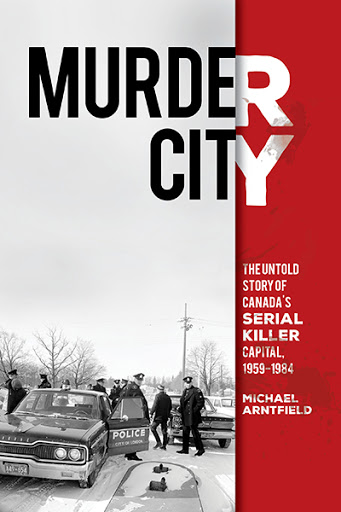
His work became the basis for the book: "Murder City: The Untold Story of Canada's Serial Killer Capital, 1954-1984". I'll add it to my reading list, because I'm actually quite touched by Alsop's efforts.

From Amazon:
"Like the mythic cities of Gotham or Gomorrah, London, Ontario was for many years an unrivalled breeding ground of depravity and villainy, the difference being that its monsters were all too real. In its coming to inherit the unwanted distinction of being the serial killer capital of not just Canada-but apparently also the world during this dark age in the city's sordid history- the crimes seen in London over this quarter-century period remain unparalleled and for the most part unsolved. From the earliest documented case of homicidal copycatting in Canada, to the fact that at any given time up to six serial killers were operating at once in the deceivingly serene "Forest City," London was once a place that on the surface presented a veneer of normality when beneath that surface dark things would whisper and stir. Through it all, a lone detective would go on to spend the rest of his life fighting against impossible odds to protect the city against a tidal wave of violence that few ever saw coming, and which to this day even fewer choose to remember. With his death in 2011, he took these demons to his grave with him but with a twist-a time capsule hidden in his basement, and which he intended to one day be opened. Contained inside: a secret cache of his diaries, reports, photographs, and hunches that might allow a new generation of sleuths to pick up where he left off, carry on his fight, and ultimately bring the killers to justice-killers that in many cases are still out there."

Yeah ... Ontario is a creepy place truly, so is the North. This post is even more ironic in light of reading some comments online where a Canadian bashed Americans for their 'serial killer filled nation'. Yes, there are all kinds of crazy in a nation of 300 million people ... but Canada creeps me out infinitely more.


Post script

I finally got around to reading this book. Let me warn you, it is disturbing. And it comes with everything you'd expect from Canada: incompetence, bumbling, and indifference that beggars belief. Serious sexual offenders and killers sentenced to 5-10 years in prison. Using techniques, technologies and systems 15+ years after they became available in the US. Brushing off serial murder or certain crimes as an "American problem", which apparently couldn't exist in the magical land of Canada.

All this and more. Of the few cases that were solved, it was generally down to sheer luck or the help of witnesses. A couple more by DNA in recent years, after the offenders died. In addition to being disturbed, be prepared for healthy doses of outrage.


Share:

Popular Posts

Blog Archive